

Polypropylene Market to Reach USD 170,100 Million by 2035 as Circular Economy and EV Lightweighting Drive Growth
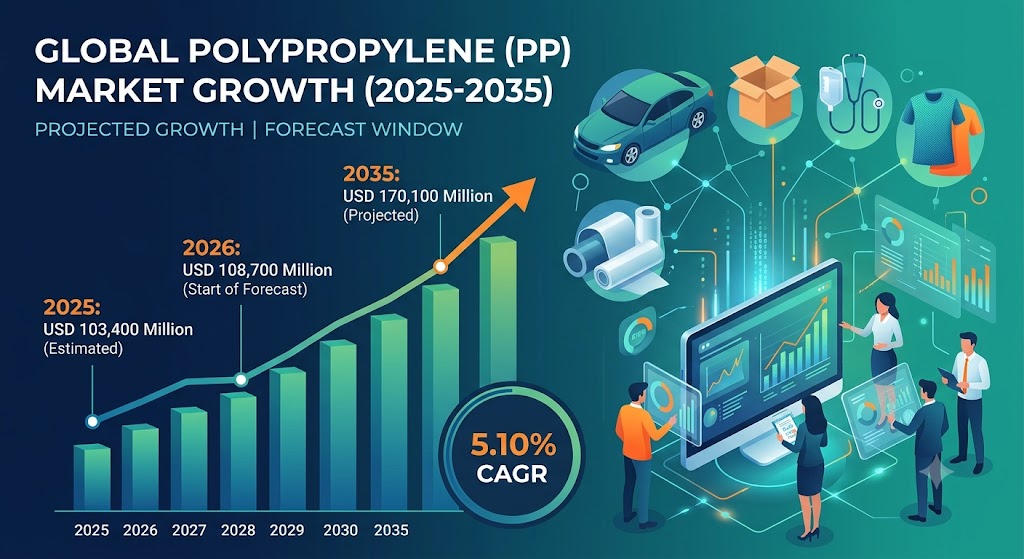
Polypropylene Market (2026 - 2035)
Asia-Pacific commands roughly 54.0% of the polypropylene market volume, driven by China's integrated refinery-petrochemical complexes
OR, UNITED STATES, July 14, 2026 /EINPresswire.com/ -- Polypropylene is the invisible backbone of modern life. It is in the yogurt container you opened this morning, the car bumper that absorbed yesterday's fender-bender, the surgical mask that protected a healthcare worker, and the battery enclosure powering the electric vehicle in your neighbor's driveway. No other thermoplastic polymer materials touch so many aspects of daily existence with such ubiquity and versatility. According to a comprehensive report by Market Research Future (MRFR), the global polypropylene market reached an estimated USD 103,400 million in 2025 and is projected to grow from USD 108,700 million in 2026 to USD 170,100 million by 2035, advancing at a compound annual growth rate of 5.10%. This trajectory reflects not merely incremental demand growth, but a structural transformation: the world's most consumed plastic is being re-engineered for recyclability, electrification, and a circular economy that will define its next decade.The Packaging Revolution: From Multi-Material to Mono-Material
The single largest driver of the polypropylene market is packaging, which commanded 46.8% of revenue in 2025. Yet this dominance is being reshaped by a regulatory and consumer-driven imperative that is as profound as it is underappreciated: the shift from multi-material laminates to mono-material polypropylene structures.
For decades, flexible plastic packaging relied on complex laminates—polyethylene terephthalate bonded to aluminum foil, bonded to ethylene-vinyl alcohol, bonded to polyethylene—to achieve the barrier properties necessary for shelf-stable food. These structures performed admirably but were essentially unrecyclable, destined for landfill or incineration. The EU's Packaging and Packaging Waste Regulation (PPWR) mandates 30% recycled content in contact-sensitive packaging by 2030, rising to 65% by 2040. India's Plastic Waste Management (Amendment) Rules enforce a progressive scale requiring at least 60% recycled content in rigid plastic packaging by 2028–2029. These regulations are not merely adding compliance costs; they are fundamentally rewriting the specification rules for plastic packaging materials.
Brand owners are responding decisively. Nestlé and Unilever have committed to switching at least 30% of flexible formats to recyclable mono-PP by 2027. Converters adopting high-barrier metallized polypropylene resin films can achieve oxygen-transmission rates below 1.0 cc/m²/day, matching aluminum-laminate performance while maintaining full recyclability. China's updated GB national standard for food-contact plastics, effective January 2025, significantly favors polypropylene over PVC substitutes, increasing PP demand by an anticipated 1.2 million tonnes by 2028.
This mono-material conversion is a structural tailwind for the polypropylene market because it channels demand away from competing resins and toward PP's unique combination of clarity, heat-seal performance, and compatibility with existing recycling infrastructure. The global output of flexible plastic packaging exceeded 28 million tonnes in 2024, and the share migrating to mono-PP constructions is growing at double-digit rates.
Download Report Sample Copy: https://www.marketresearchfuture.com/sample_request/1063
Automotive Lightweighting: The EV Multiplier Effect
The second major demand pillar is automotive, the fastest-growing end-use segment at a 6.53% CAGR. Two forces are converging: regulatory mandates to cut vehicle curb weight and the electrification supercycle that is increasing plastic content per vehicle.
Euro 7 emission standards and the U.S. EPA's 2027 tailpipe rules pressure OEMs to cut vehicle curb weight by 5–8%, spurring the replacement of metal brackets, air ducts, and battery housings with injection molding plastics based on polypropylene compound. PP consumption per vehicle is projected to rise from 42 kg today to 56 kg by 2032, with talc-filled and glass-fiber-reinforced automotive plastic components capturing the bulk of new application wins.
The electrification wave adds a multiplier effect. The International Energy Agency projects global EV sales will surpass 45 million units annually by 2030, each consuming 15–20% more polypropylene compound than an equivalent internal combustion engine vehicle. Battery module housings, cable conduits, thermal shields, and under-body shields all demand flame-retardant, electrically insulating, lightweight polymer materials. Polypropylene compounds reinforced with mineral fillers meet UL 94 V-0 ratings at 30–40% lower density than nylon alternatives, positioning automotive plastic components producers to capture an incremental USD 4.2 billion addressable segment by 2032.
Hyundai-Kia alone earmarked USD 320 million for lightweight polymer materials integration across its EV platform portfolio through 2029. Tier-1 suppliers such as Magna, Faurecia, and Yanfeng are expanding compounding lines dedicated to automotive plastic components, reflecting a structural shift that will persist through the forecast horizon.
The Catalyst Revolution: Unlocking New Applications
A generational technology shift is underway as legacy Ziegler-Natta catalyst platforms give way to advanced metallocene and post-metallocene systems. These next-generation catalysts unlock high-melt-strength polypropylene resin grades capable of foaming, thermoforming, and bi-axial stretching—applications historically dominated by polystyrene and polyethylene terephthalate.
Metallocene and post-metallocene catalysts enable tighter molecular-weight distribution, improving clarity and melt strength in lightweight polymer materials. Producers investing in proprietary catalyst platforms command premium pricing and higher operating margins. Major producers have collectively committed more than USD 2.8 billion toward specialty catalyst R&D and commercial-scale reactor retrofits between 2024 and 2028, targeting lightweight polymer materials for automotive interiors, food-contact flexible plastic packaging, and medical non-wovens.
Homopolymer polypropylene resin dominates the market with a 64.0% share in 2025, driven by superior stiffness, low density, and favorable processing economics in high-volume injection molding plastics and biaxially oriented polypropylene (BOPP) film lines. Food-contact-grade homopolymer remains the backbone of rigid containers for dairy, snacks, and ready-meal applications.
Copolymer grades—both random and impact—are the fastest-growing segment at a 5.48% CAGR, driven by automotive OEMs specifying polypropylene resin compounds with ethylene-propylene rubber phases for bumper fascia, battery casings, and interior trim. Random copolymer's transparency and low-temperature toughness also position it strongly in flexible plastic packaging for frozen food and medical device packaging.
PDH Capacity Expansion: Reshaping the Feedstock Map
The global polypropylene market is being reshaped from the supply side by massive investments in propane dehydrogenation (PDH) capacity. Over 12 million tonnes of on-purpose propylene capacity were added by PDH units between 2020 and 2025, significantly changing the feedstock cost curve. In 2024, PDH margins on the U.S. Gulf Coast averaged USD 180/tonne, while naphtha-based steam crackers in Northwest Europe averaged USD 90/tonne—a structural gap that is redirecting trade flows and investment decisions.
By 2027, a further 6 million tonnes of integrated PDH-PP trains will enter service from Chinese operators such as Zhejiang Petrochemical and Hengli Petrochemical, strengthening Asia-Pacific's cost leadership in polymer manufacturing materials. U.S. Gulf Coast PDH expansions by Enterprise Products Partners and Flint Hills Resources have added over 3 million tonnes per year of on-purpose propylene since 2022, positioning the United States as a net exporter of polypropylene resin for the first time in a decade.
This feedstock diversification matters because it reduces the polypropylene market's historical dependence on naphtha crackers tied to volatile crude oil prices. PDH economics are driven by propane-ethane spreads and shale-gas abundance—factors that have proven more stable than crude oil cycles. For downstream converters, this translates into more predictable input costs and greater willingness to commit to long-term supply contracts.
Non-Wovens and Hygiene: The Demographic Dividend
Meltblown and spunbond polypropylene resin consumed in hygiene products, geotextiles, and medical gowns exceeded 7.5 million tonnes globally in 2024. Aging demographics in Japan and Europe, combined with rising hygiene-product penetration in Southeast Asia, underpin a projected 6.1% annual volume growth in non-woven PP through 2030.
This segment adds meaningful high-margin volume for industrial plastic products producers, diversifying end-market exposure beyond commodity film and injection molding plastics. Hygiene-product consumption per capita in Sub-Saharan Africa and South Asia remains below 15% of OECD levels, representing a long-term growth frontier as rising disposable incomes and government maternal-health programs in Nigeria, Bangladesh, and Indonesia drive double-digit annual growth in spunbond PP demand.
Buy Now Report: https://www.marketresearchfuture.com/checkout?currency=one_user-USD&report_id=1063
Regional Dynamics: Asia-Pacific Dominates, All Regions Expand
Asia-Pacific commands roughly 54.0% of the polypropylene market volume, the largest regional share, and simultaneously registers the fastest projected CAGR. China alone accounts for 46.2% of regional share, with Zhejiang Petrochemical and Shenghong Petrochemical operating world-scale integrated refinery-PDH-PP complexes that combine cost-efficient feedstock with port logistics. India's polypropylene market is accelerating at a 6.40% CAGR as Reliance Industries and Indian Oil Corporation commission new PP trains aligned with the government's Make in India and Production-Linked Incentive (PLI) schemes for technical textiles and plastic packaging materials.
Japan contributes USD 5,100 million through high-performance automotive plastic components and medical non-wovens. South Korea's electronics enclosures and battery-related plastic compound materials sustain 7.8% of regional share. The ASEAN bloc is growing at a 5.90% CAGR, driven by consumer goods penetration and agricultural films.
Europe holds the second-largest share at 18.4%, buoyed by stringent recycling targets that incentivize thermoplastic polymer materials over thermosets. Germany anchors regional demand at 24.8% of regional share through its automotive plastic components supply chain serving BMW, Volkswagen, and Mercedes-Benz EV platforms. The UK's 4.85% CAGR reflects flexible plastic packaging recyclability mandates, while France's USD 2,540 million market is driven by food-grade plastic packaging materials conversion.
North America accounts for 15.2% of global volume, benefiting from shale-derived propylene feedstock economics that keep production costs structurally competitive. The United States dominates with 72.5% of regional share, where PDH capacity and recycled-content mandates create a diversified demand base. Canada's automotive corridor in Ontario is absorbing growing volumes of lightweight polymer materials for EV battery-tray assemblies, while Mexico's plastics-conversion sector benefits from nearshoring as multinational OEMs relocate injection molding plastics capacity closer to North American assembly plants.
South America is advancing at a 5.60% CAGR, with Brazil dominating at 62.4% of regional share through Braskem's operations and piloting of green propylene pathways from bio-ethanol. The Middle East & Africa, valued at USD 6,820 million, is driven by Saudi Arabia's Vision 2030 downstream-integration program and Borouge's Ruwais complex expansion targeting export markets across Africa and South Asia.
The Circular Economy: Chemical Recycling as Game-Changer
Perhaps the most transformative trend reshaping the polypropylene market is the emergence of chemical recycling at commercial scale. Technologies for solvent-based dissolution and advanced physical purification are opening circular feedstocks that were previously inaccessible.
LyondellBasell's MoReTec thermal chemical recycling infrastructure and PureCycle Technologies' commercial purification facility in Ironton, Ohio, demonstrate that divergent post-consumer PP waste streams can produce near-virgin-quality polypropylene resin at scale. PureCycle achieved first commercial-grade pellet output from its Ironton facility in January 2024, validating ultra-pure recycled polypropylene resin production. LyondellBasell commenced commercial operation of its MoReTec plant in Wesseling, Germany, in March 2025, processing 50,000 tonnes per year of mixed plastic waste into recycled polypropylene resin feedstock.
SABIC signed a 10-year offtake agreement with Plastic Energy in November 2024 for pyrolysis oil supply to its TRUCIRCLE circular polymer manufacturing materials portfolio, targeting 200,000 tonnes per year of certified-circular polypropylene resin by 2028. Brand-owner offtake agreements for committed recycled-PP quantities already surpass 400,000 tonnes per year through 2028, creating a premium pricing tier of USD 200–350 per tonne above virgin benchmarks.
Chemical recycling capacity for polypropylene resin is projected to exceed 3.5 million tonnes globally by 2030, up from roughly 250,000 tonnes in 2024. MRFR expects recycled PP to represent 8–10% of total polypropylene market volume by 2035, supported by Extended Producer Responsibility (EPR) fee differentials that make virgin resin economically unattractive for certain flexible plastic packaging formats.
Emerging Opportunities: Digital Twins, Bio-Based Pathways, and AI
Several transformative trends are poised to reshape the polypropylene market. Digital process twins and AI-optimized extrusion are reducing scrap rates by 12–18% and energy consumption by 8%, according to a 2024 VDMA study. Real-time digital twins of extrusion and injection molding plastics lines, powered by machine-learning process models, enable polymer manufacturing materials producers to optimize grade changeovers—historically a major source of off-spec product and scrap.
Machine-learning-driven process control can reduce cycle times by 6–10% while cutting defect rates, according to McKinsey's 2025 advanced-manufacturing survey. Early adopters report payback periods under 18 months on AI platform investments. Licensing these AI-driven optimization platforms to mid-tier converters represents a recurring-revenue opportunity for technology-forward polypropylene market participants.
Bio-based polypropylene pathways are approaching commercial viability. Braskem is piloting green propylene from bio-ethanol, aligning with South America's bio-economy aspirations. While bio-based PP is unlikely to exceed 3–5% of total supply by 2035, it diversifies the feedstock portfolio and aligns with corporate net-zero commitments from brand owners.
ESG reporting and Scope 3 decarbonization are becoming procurement criteria. Mandatory Scope 3 disclosure under the EU Corporate Sustainability Reporting Directive and proposed SEC climate rules compel brand owners to track embedded carbon across their plastic compound materials supply chains. Polypropylene resin producers with lower-carbon production routes—PDH powered by renewable electricity or bio-based feedstocks—will command preference in procurement tenders. Carbon-intensity certifications such as ISCC PLUS are expected to become competitive differentiators well before 2030.
Read Report Summary: https://www.marketresearchfuture.com/reports/polypropylene-market-1063
Competitive Landscape
The polypropylene market exhibits medium concentration, with the top five producers accounting for an estimated 32–38% of global capacity and a Herfindahl-Hirschman Index in the 600–900 range. Scale, feedstock integration, and catalyst technology differentiate leaders from mid-tier polymer manufacturing materials operators.
LyondellBasell Industries leads with an estimated 7–10% revenue share, distinguished by integrated PDH-PP operations and circular-economy leadership through its MoReTec recycling platform. SABIC captures 6–9% through Middle East feedstock advantage and global compounding reach, with its TRUCIRCLE circular portfolio targeting 200,000 tonnes per year of certified-circular resin by 2028. ExxonMobil Chemical holds 5–8% through its advanced metallocene catalyst platform and Achieve PP grades. Braskem accounts for 4–7% as Latin America's capacity leader with bio-PP pilot operations. Sinopec is the largest Chinese producer at 5–8%, operating integrated refining complexes with world-scale PP trains.
Related Report
Zinc Market https://www.marketresearchfuture.com/reports/zinc-market-8003
India Iron Steel Market https://www.marketresearchfuture.com/reports/india-iron-steel-market-21393
Market Research Future
Market Research Future
+1 855-661-4441
email us here
Legal Disclaimer:
EIN Presswire provides this news content "as is" without warranty of any kind. We do not accept any responsibility or liability for the accuracy, content, images, videos, licenses, completeness, legality, or reliability of the information contained in this article. If you have any complaints or copyright issues related to this article, kindly contact the author above.
